cs/01 · b2b saas · asbl
ASBL Progress - Enterprise B2B SaaS
Construction Management Platform
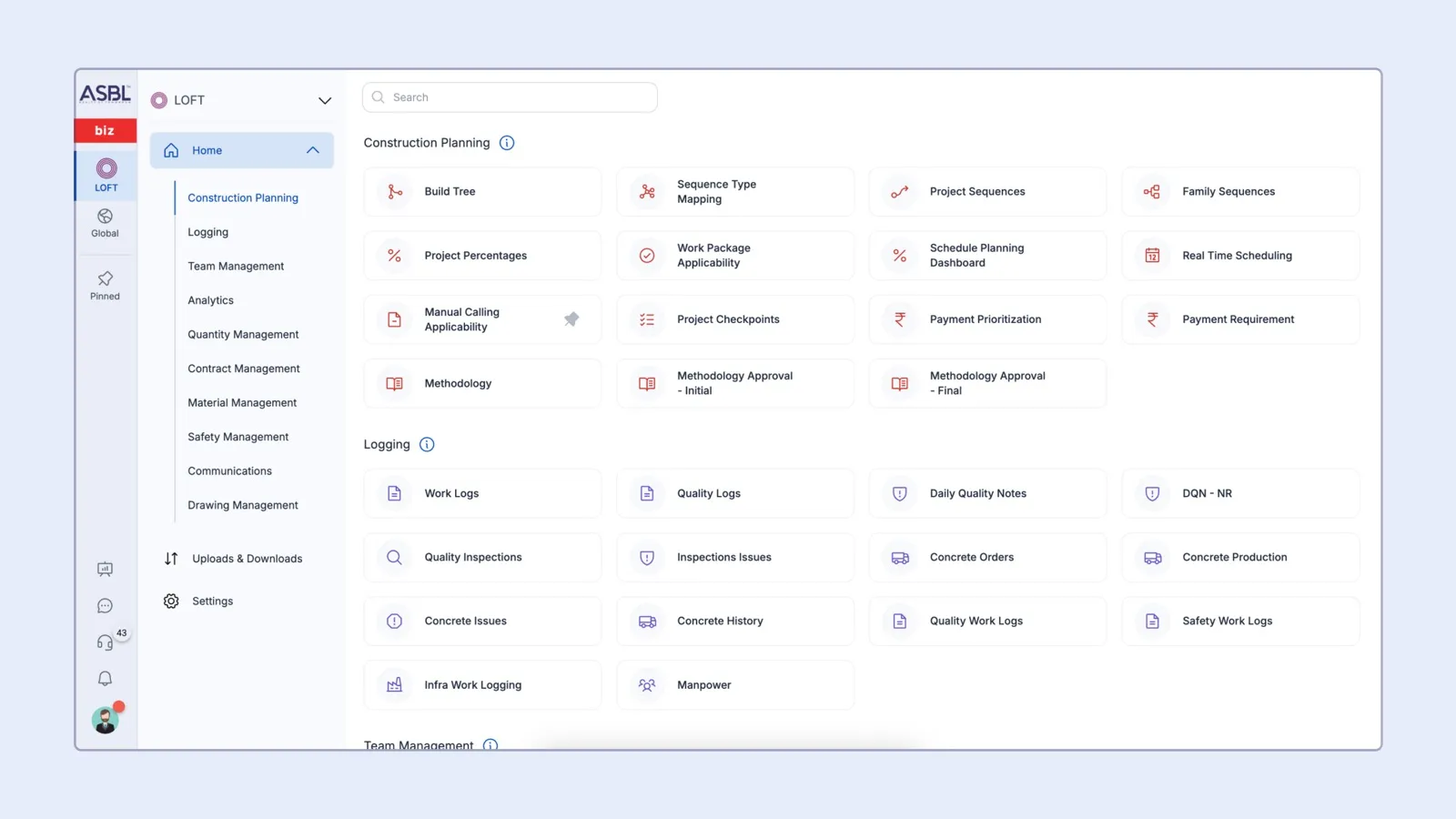
Problem
ASBL was scaling its construction management platform across planning, procurement, site execution, and project tracking, but the product experience was fragmented. Teams were working across disconnected tools, overlapping workflows, and inconsistent interfaces.
For site engineers, procurement teams, and project managers, that meant more time reconciling information and less time moving work forward. For design and engineering, every new module increased rework because patterns were not systemized.
Role
I led product design for the platform experience, shaped the design-system foundation in Figma, designed core enterprise workflows, and worked closely with developers to turn the system into a reusable delivery model.
Constraints
- The product spanned multiple enterprise workflows, each with different users, priorities, and terminology.
- Design files, patterns, and handoff practices were fragmented, creating drift between design and engineering.
- Operational teams still relied on Excel, email, and ad hoc communication, so digital trust was low.
- The system needed to scale without forcing teams to relearn interactions across every new module.
Process
I began by mapping the ecosystem: users, touchpoints, and workflow gaps across civil, planning, procurement, and finance. We interviewed 15 stakeholders to understand where digital operations were breaking down and where coordination slowed the business.
Three patterns stood out:
- Redundant effort: The same information was being recreated across spreadsheets, ERP, WhatsApp, and internal tools.
- Inconsistent interfaces: Navigation, hierarchy, and behavior changed from module to module.
- Slow iteration loops: Designers and developers lacked a reusable system, so every change created fresh ambiguity.
From that, we aligned on two outcomes: reduce design-to-development delivery time by 50% and improve cross-team workflow efficiency by 75%.
Decisions
I made the project successful by treating it as both a workflow redesign and a systems-design problem.
- Built a token-based design system: I standardized color, type, spacing, and components so teams could scale screens and modules from a shared foundation instead of rebuilding patterns manually.
- Designed around enterprise workflows, not isolated screens: I focused on procurement, supply chain, support, and permissions as connected parts of the same product ecosystem.
- Introduced predictable interaction models: Shared layout rules, hierarchy, and behavior reduced relearning across modules.
- Supported DesignOps adoption: Documentation, naming conventions, and developer-facing specs made the system usable beyond the Figma file itself.
- Automated repetitive system work: I developed an internal Figma plugin to speed up token updates, component generation, and system maintenance.
Outcome
The result was a more cohesive enterprise platform: shared UI foundations, clearer workflows, and less friction between product design and engineering. Teams could build faster because modules no longer started from scratch, and users experienced a more reliable product language across the system.
Alongside the platform work, I mentored four designers on token usage, variant structure, and documentation practices, helping move the team from one-off screen making to system-led product design.
Impact
- 75% improvement in overall design-to-delivery workflow efficiency.
- 50% reduction in handoff ambiguity and rework.
- 25% increase in feature visibility through improved dashboard structures.
- Four project websites redesigned using the same token foundation, increasing lead procurement from 5K to 50K per month.
- Reduced user issues by 20% through structured usability testing and shared component patterns.
Beyond the metrics, the bigger shift was cultural. Design became shared infrastructure across product, engineering, and operations instead of a layer applied at the end.
Request Access to Design File